Loading project
Preparing this case study...
Preparing this case study...
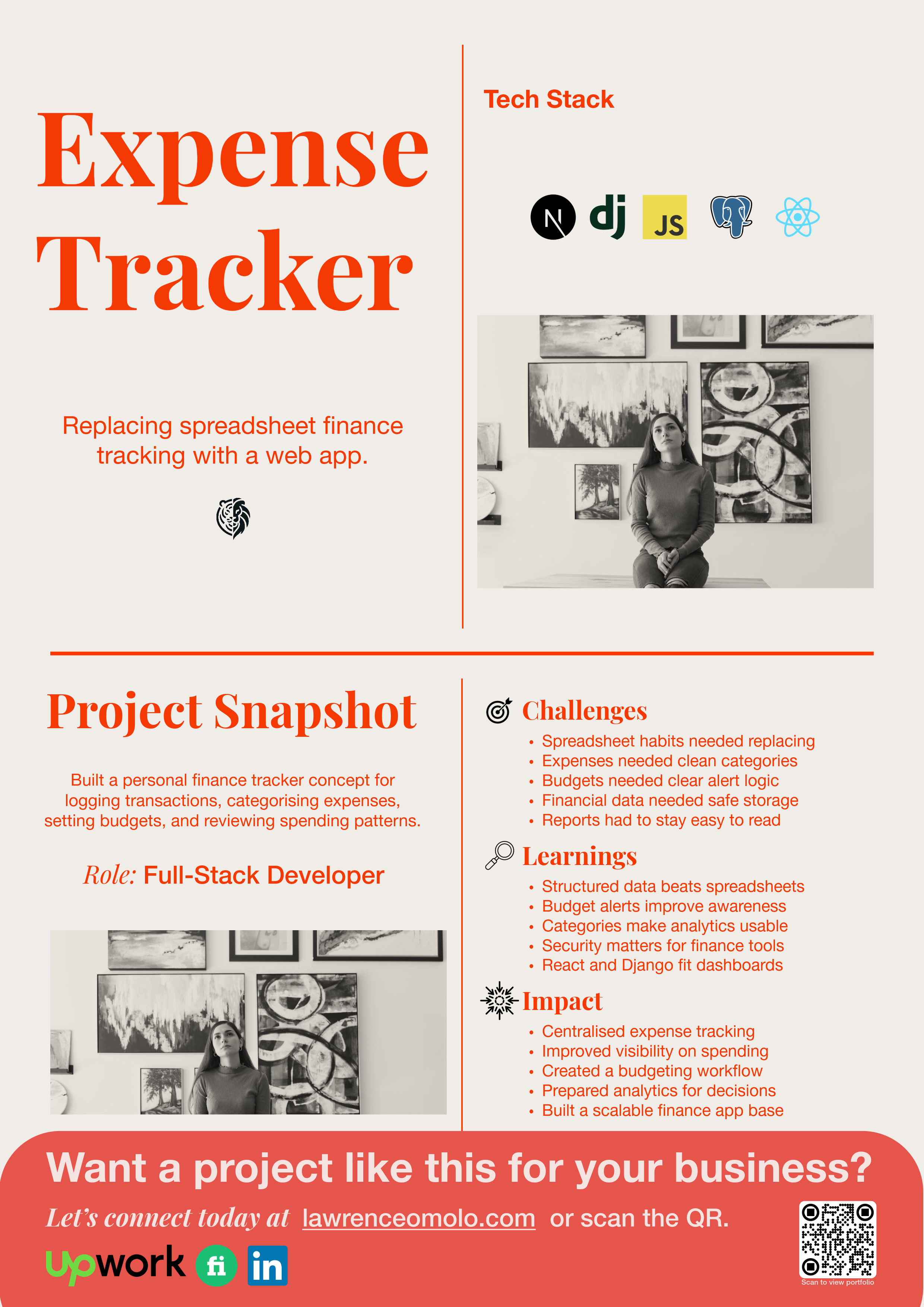
A Django and React-powered personal expense tracker that provides budgeting, analytics, and transaction management to simplify financial tracking and improve spending habits.
Project Snapshot
Technical Footprint
The Expense Tracker is a personal finance management application designed to replace spreadsheet-based expense tracking with a structured, automated system. This project aims to simplify financial tracking, budgeting, and spending analysis for personal use, ensuring better financial discipline and real-time insights.
The application is built using React (frontend) and Django (backend), with PostgreSQL for structured financial data storage. It allows users to log transactions, categorise expenses, track financial goals, and generate reports. With budgeting features, automated alerts, and secure cloud storage, this tracker eliminates the manual hassle of spreadsheet-based tracking.
🔹 Frontend Development (React + TailwindCSS)
🔹 Backend Development (Django & Django REST Framework)
🔹 Database Management (PostgreSQL)
🔹 Automation & Integrations
1️⃣ Transitioning from a Spreadsheet to a Fully Functional App
Challenge: Moving from manual spreadsheet tracking to an interactive, structured system.
Solution: Designed a database schema that mimics a well-organized spreadsheet structure but offers automation and better insights.
2️⃣ Organizing Expenses Efficiently
Challenge: Ensuring that all expenses are categorized correctly for easy analysis.
Solution: Implemented custom category assignments, filtering, and a budgeting system.
3️⃣ Budget Management & Overspending Alerts
Challenge: Users often exceed budgets without realizing it.
Solution: Introduced budget-setting features with push notifications for overspending alerts.
4️⃣ Data Security & Accessibility
Challenge: Ensuring financial data is secure, backed up, and accessible on multiple devices.
Solution: Used JWT authentication, encrypted PostgreSQL storage, and cloud-based backup options.
Eliminates Manual Spreadsheet Hassles
Helps Monitor Spending Patterns
Enhances Budgeting & Financial Awareness
Ensures Secure & Accessible Expense Tracking
Future Expansion Possibilities
📌 Automating Expense Tracking is More Efficient
Having a centralized dashboard with categorized expenses makes it easier to review spending trends.
📌 Budgeting Features are Crucial for Financial Discipline
Setting spending limits and tracking against budgets in real-time helps prevent overspending.
📌 Cloud-Based Data Storage is a Game Changer
Unlike spreadsheets, PostgreSQL provides structured storage, ensuring long-term financial data retention.
📌 React + Django is an Ideal Stack for Financial Apps
The React frontend provides a seamless user experience, while Django offers robust API handling for secure financial data management.
I help founders and teams turn messy ideas into reliable systems — from MVPs and APIs to AI-enabled automation workflows.