Loading project
Preparing this case study...
Preparing this case study...
A Next.js and Django-powered job application tracker that helps freelancers and job seekers manage applications, track interviews, set follow-up reminders, and analyze success rates.
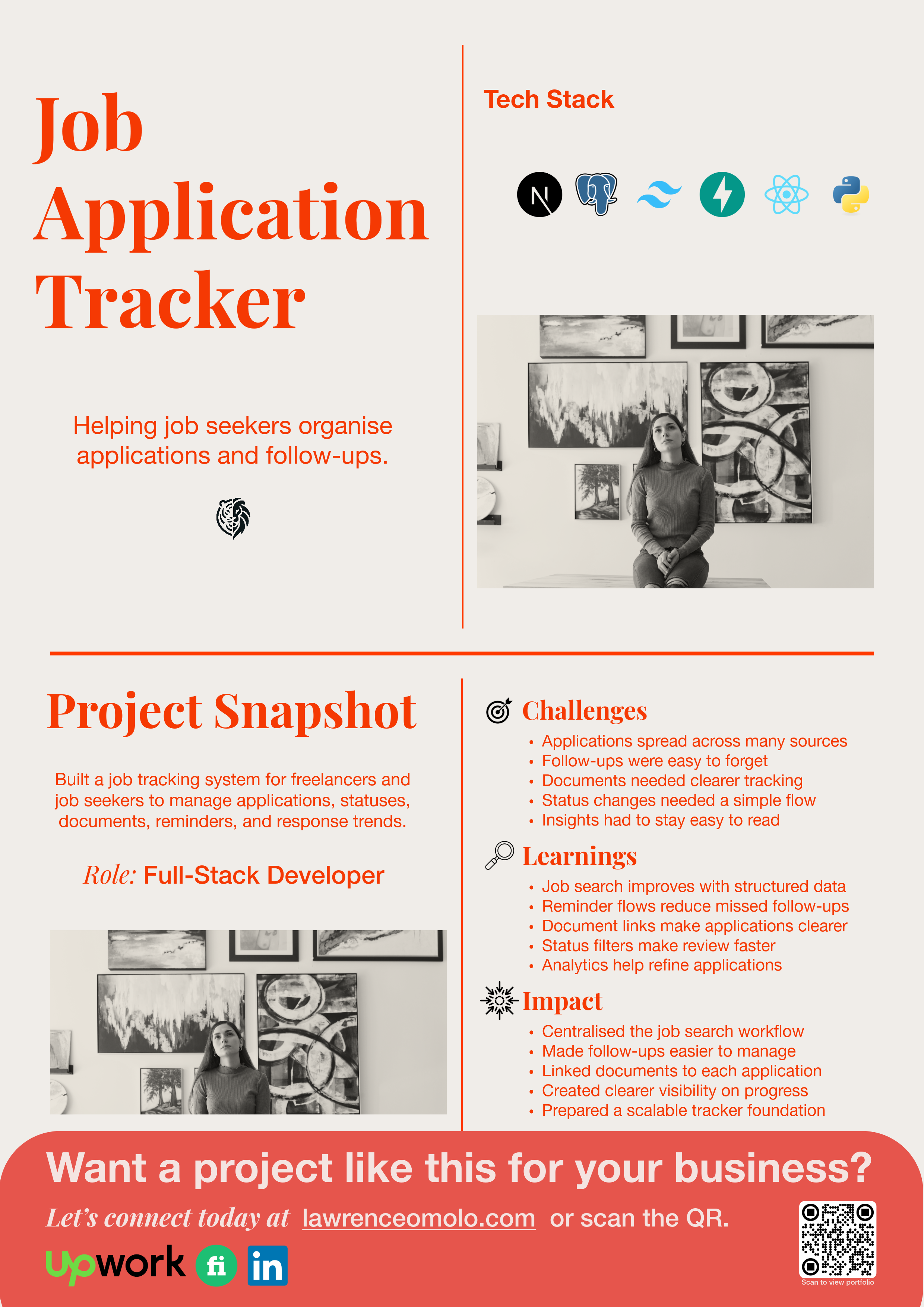
Project Snapshot
Technical Footprint
The Job Application Tracker is a personal productivity tool designed to help freelancers and job seekers manage and track job applications efficiently. As a freelance full-stack developer, keeping track of applications, follow-ups, and responses is crucial for optimising the job search process.
This system allows users to organise job applications, monitor statuses, store important documents, and analyse application trends. With integrations for LinkedIn, Upwork, and Fiverr APIs, the tracker automates job listing imports and status updates, ensuring that users never miss an opportunity.
Built with Next.js for the frontend, Django for the backend, and PostgreSQL for structured data storage, the platform is designed to be fast, secure, and easily scalable.
🔹 Frontend Development (Next.js & TailwindCSS)
🔹 Backend Development (Django & Django REST Framework)
🔹 Database Management (PostgreSQL)
🔹 Automation & Integrations
1️⃣ Organising Job Applications Across Multiple Platforms
Challenge: Managing applications from multiple job sources (Upwork, LinkedIn, direct emails, Fiverr, etc.) was difficult.
Solution: Implemented a centralised job list where all applications are logged and categorized.
2️⃣ Tracking Responses & Follow-Ups Efficiently
Challenge: Forgetting to follow up on applications or track recruiter responses.
Solution: Added custom statuses & automated reminders to notify when to follow up.
3️⃣ Managing Multiple Resume & Cover Letter Versions
Challenge: Keeping track of which resume/cover letter was used for each job application.
Solution: Implemented document storage so each application can be linked to a specific resume version.
4️⃣ Measuring Application Success Rate & Optimization
Challenge: Understanding which applications were performing best and improving based on insights.
Solution: Built analytics dashboards for tracking response rates, interview conversions, and success rates.
5️⃣ Ensuring Secure Storage & Accessibility
Challenge: Protecting job application data and allowing access across devices.
Solution: Used JWT authentication, OAuth login (Google/LinkedIn), and PostgreSQL cloud backup.
Streamlined Job Search Process
Organising applications in one place eliminated confusion and guesswork.
Improved Follow-Ups & Interview Conversions
Automated email reminders & notifications led to better recruiter engagement.
Optimized Resume & Cover Letter Strategy
Tracking which versions performed best helped tailor future applications.
Secure & Scalable Job Tracking
The Django backend with PostgreSQL provided a secure, scalable system.
Multi-Platform Compatibility
The tracker was designed to be accessible on both desktop and mobile.
📌 Structured Data Improves Job Search Management
Categorising applications, tagging job sources, and tracking status updates made job hunting more efficient.
📌 Follow-Up Automation Increases Response Rates
Setting reminders improved follow-up consistency and led to higher recruiter engagement.
📌 Data-Driven Decisions Help Improve Applications
Monitoring analytics helped refine application strategies (e.g., tweaking resumes based on platform response rates).
📌 Cloud-Based & Multi-Device Support is Essential
Using PostgreSQL cloud storage ensured that job data was accessible anywhere without data loss.
📌 Integrating APIs Simplifies Workflow
Pulling job data automatically from LinkedIn, Upwork, and Fiverr reduced manual entry work.
I help founders and teams turn messy ideas into reliable systems — from MVPs and APIs to AI-enabled automation workflows.