Loading project
Preparing this case study...
Preparing this case study...
A governed AI workforce operating system that manages tasks, agents, departments, tools, approvals, workflows, logs, and execution through one structured command centre.
Project Snapshot
Technical Footprint
BEIA OS is my AI Workforce Operating System, built to help me run life, business, execution, accountability, and long-term growth through a governed digital workforce.
This is not a normal productivity app or a simple chatbot. I built it around the idea that one human owner can operate with a structured AI workforce behind them, where every action has a role, a task, a route, a risk level, a log, and a clear authority chain.
The system is structured like a real organisation. At the top is the BEIA Sovereign, which represents mission, alignment, and direction. Beneath that is a Circle of Council made up of six cross-functional agents covering time, income, build, content, scheduling, and systems. Under the company execution layer sits the LOJ CEO, seven shared departments, team heads, and worker agents that can be spawned for specific work.
The most important rule in the system is simple: every meaningful action must trace back to a Task. No agent acts outside a task context. No tool is called without a task ID. No result is accepted without a task record, task log, and execution trail. That is what keeps the system from becoming a random group of AI agents.
BEIA OS is built around a strict execution chain: Task Engine, Orchestrator, Tool Gateway, Governance Layer, Success Engine, and Worker Factory. Each layer has a job. The Task Engine records work. The Orchestrator routes it. The Tool Gateway controls execution. Governance handles risk and approvals. The Success Engine measures outcomes. The Worker Factory creates controlled workers from approved templates.
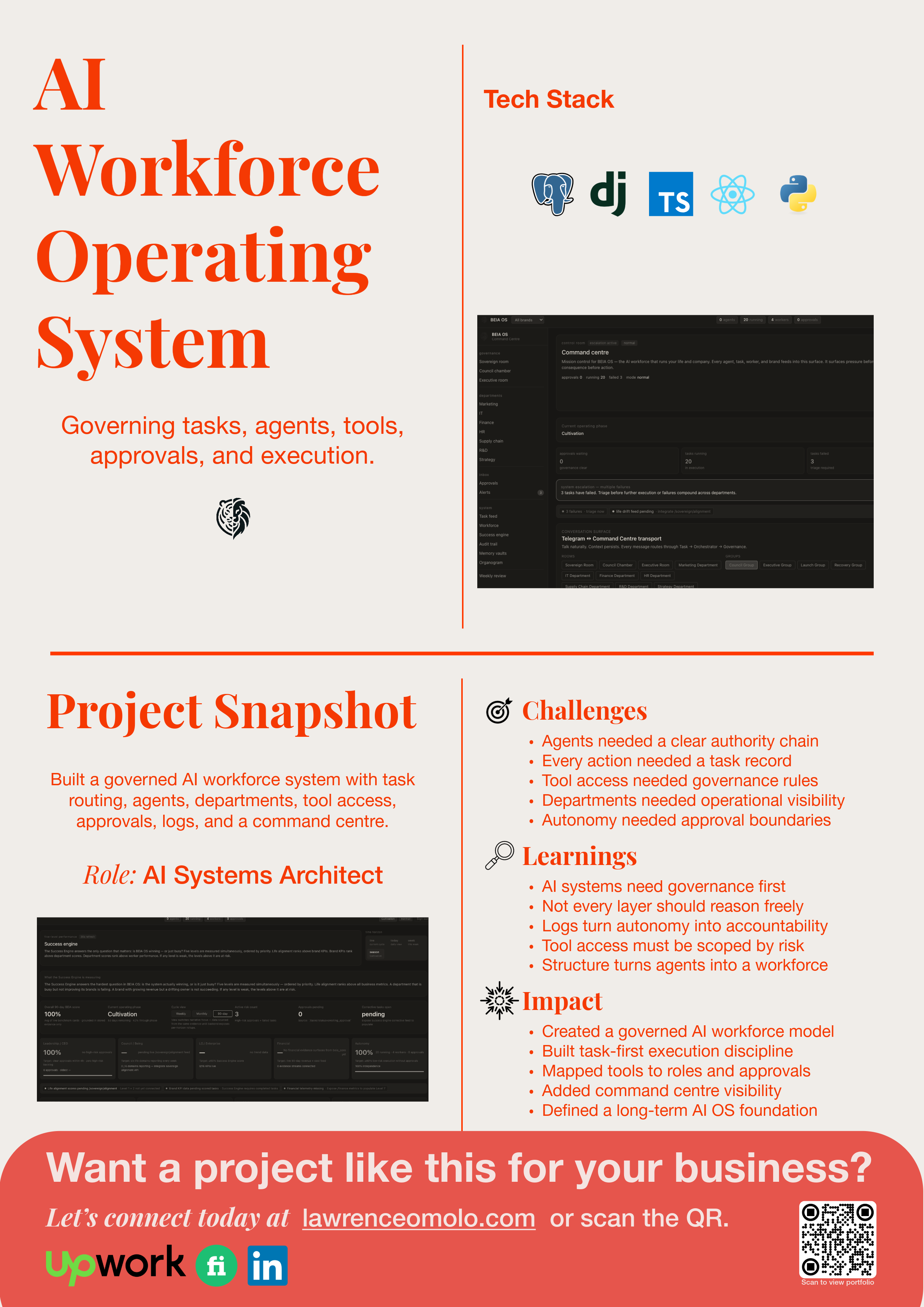
A major part of the work was building the Command Centre, which acts as the operational control room. It is not just a dashboard. It shows live tasks, workflow movement, agents, approvals, blocked work, pressure, season awareness, conversation surfaces, and the rooms where the system is governed. Recent optimisation work added authentication, protected routes, phase awareness, backend-driven department truth, conversation surfaces across rooms, and workflow visibility inside the primary operational rooms.
The system is also designed around real tool access. The BEIA Tool Bible defines which tools Council agents, departments, teams, and workers are allowed to use, including Google Workspace, GitHub, Stripe, ERPNext, deployment platforms, social platforms, marketplace tools, local workspace tools, internal BEIA tools, and the Tool Gateway. Tool access is scoped by team, task, risk level, environment, and approval rules.
What makes BEIA OS different is the level of governance behind it. It is designed so that AI can help operate a real life and business portfolio without becoming reckless. Low-risk work can move faster, medium-risk work needs CEO or Chief approval, and high-risk work requires my approval. Everything important is logged, auditable, and tied back to the system structure.
I designed the BEIA OS concept, operating doctrine, hierarchy, task principle, agent structure, governance model, tool access rules, Command Centre experience, and long-term execution roadmap.
I worked on the backend architecture around the Task Engine, Orchestrator, Tool Gateway, Governance Layer, Success Engine, Worker Factory, TaskLog, ToolExecutionLog, risk levels, task lifecycle, worker templates, and approval flow.
I also shaped the Command Centre frontend so the system can be used operationally, not just theoretically. That included protected access, live phase awareness, workflow visibility, conversation surfaces, room-based control, backend-driven department data, and operational views across Sovereign, Council, Executive, and Department rooms.
I created the doctrine and tool structure that defines how agents, teams, workers, departments, tools, deliverables, integrations, account access, approvals, and audit logs fit together.
One of the biggest challenges was stopping the system from becoming a loose collection of AI agents. A normal agent setup can quickly become messy because every agent wants to reason, act, and make decisions at the same time. BEIA OS needed a proper chain of authority so that intelligence, execution, approval, and accountability did not collapse into one uncontrolled layer.
Another challenge was making the system complex enough to reflect real life, but structured enough to remain usable. It needed to support personal life, business operations, brands, departments, agents, workers, tools, memory scopes, tasks, approvals, and audit logs without becoming impossible to manage.
The hardest architectural rule was keeping everything task-bound. Every action has to trace back to a Task, every tool call has to be logged, and every worker has to operate inside a defined scope. That discipline makes the system slower to design, but much safer and more reliable.
A further challenge was connecting the operating model to real tools. BEIA OS is not just planning work in theory. It is designed to interact with real-world systems like Google Workspace, GitHub, Stripe, ERPNext, deployment providers, marketing platforms, marketplace tools, local development tools, and internal BEIA tools, but only through governed access rules.
BEIA OS gives me a central operating system for managing my work, brands, life structure, business execution, content, income, systems, development, and long-term goals.
As a portfolio project, it shows my ability to design and build beyond standard CRUD applications. It demonstrates backend architecture, AI workflow design, multi-agent systems, governance modelling, task orchestration, tool access control, command centre design, and operational thinking.
It also represents the direction I am moving in as a developer and entrepreneur: building AI-powered systems that do not just generate outputs but help organise real work, enforce accountability, and support long-term execution.
The system gives me a foundation for running a governed AI workforce over a real business portfolio rather than relying on isolated tools, scattered notes, or disconnected assistants.
This project taught me that AI systems need governance as much as intelligence. The impressive part is not just making an agent respond. The real work is to ensure the system knows who is allowed to act, what they are allowed to access, which risk level applies, and when the human owner must approve the decision.
I also learned that not every part of an AI system should “think”. Some layers need reasoning, but others should be deterministic and reliable. BEIA OS follows that principle by separating sovereign reasoning, council advice, CEO decision-making, team head planning, worker execution, and tool-backed actions.
The project also pushed me to think like a systems architect rather than just a developer. I had to design task lifecycles, agent hierarchy, governance rules, worker spawning, logging, tool boundaries, command surfaces, memory scopes, and operational visibility as one connected system.
The biggest learning was that autonomy only works when there is structure. Without logs, approvals, task ownership, and clear boundaries, AI becomes noise. With the right structure, it becomes a workforce.
I help founders and teams turn messy ideas into reliable systems — from MVPs and APIs to AI-enabled automation workflows.