Loading project
Preparing this case study...
Preparing this case study...
A React and OpenAI MVP that turns rough startup ideas into scoped development briefs with MVP features, tech stack, cost estimates, and timelines.
Project Snapshot
Technical Footprint
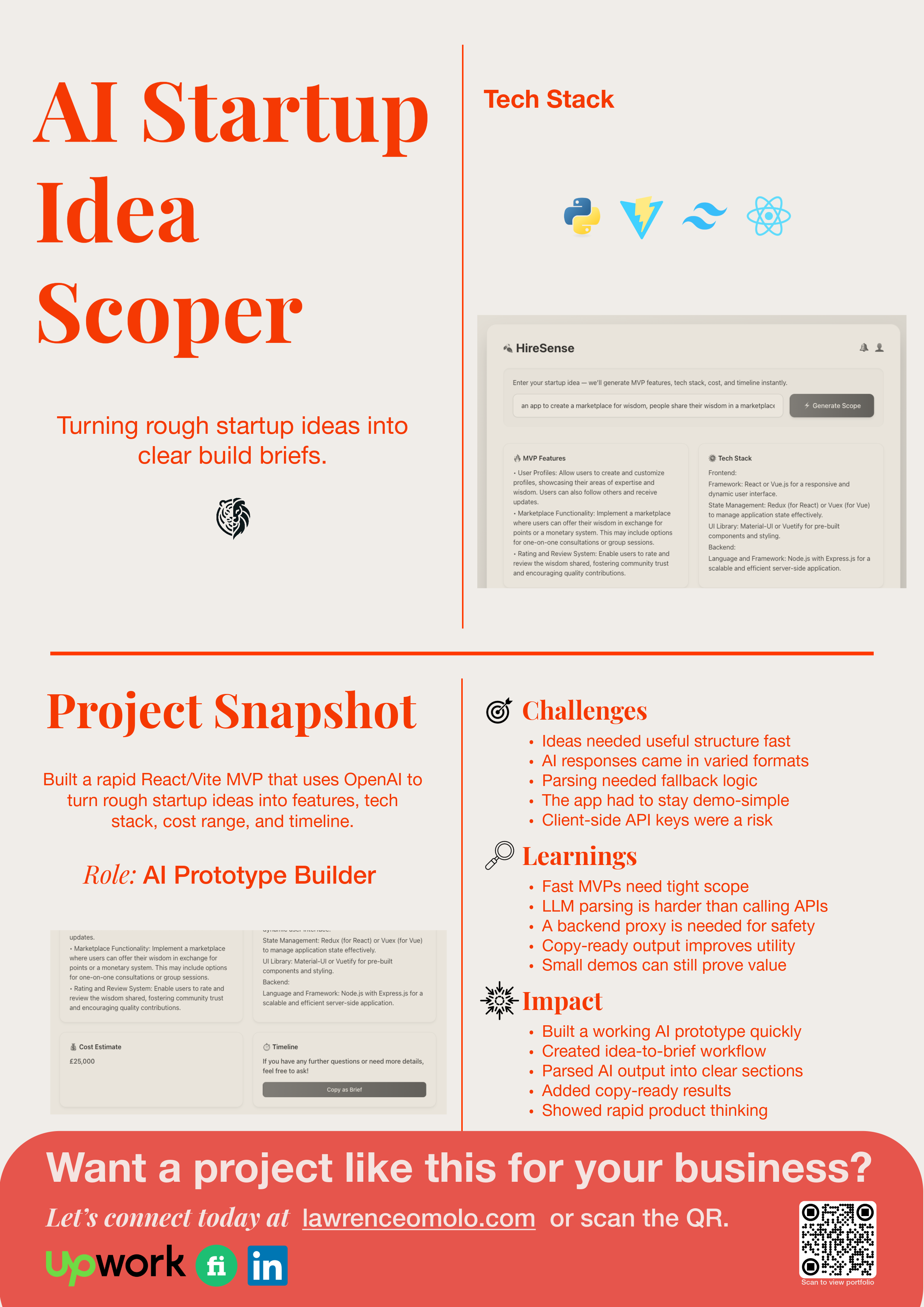
HireSense is a lightweight AI-powered idea scoping tool built to turn rough startup ideas into simple development briefs.
The project was built as a rapid MVP for a live build challenge. The user enters a startup idea, and the app uses OpenAI to generate a structured outline covering MVP features, suggested tech stack, estimated cost range, and realistic development timeline.
The app is frontend-only, built with React, Vite, and Tailwind CSS. The main logic lives inside a single React component, handling the user input, OpenAI request, response parsing, loading state, error handling, and final UI output.
One of the strongest parts of the project is the custom response parser. Instead of just displaying raw AI text, the app tries to extract the response into clear sections: MVP features, tech stack, cost estimate, and timeline. It also includes fallback logic for detecting technology keywords, cost patterns, and duration estimates when the model response is not perfectly formatted.
This is not a production SaaS and not a recruitment platform. There is no backend, database, authentication, saved project history, or secure API proxy. The OpenAI key is currently exposed client-side, so the project would need a backend layer before being used publicly. Its value is as a fast, focused AI prototype that demonstrates rapid product thinking, frontend development, and practical LLM integration.
I built the React/Vite frontend, OpenAI integration, idea input flow, response parser, loading state, error handling, result cards, and copy-to-clipboard functionality.
I also shaped the MVP around a clear founder workflow: enter a rough idea, generate a development brief, review the MVP features, tech stack, cost estimate, and timeline, then copy the result for later use.
One of the main challenges was building something useful quickly within a tight MVP scope. The app needed to take a vague idea and return something structured enough to be useful for a founder or developer conversation.
Another challenge was dealing with unstructured AI output. Even when the prompt asks for clear sections, the model may return wording in different formats, so the app needed parsing logic to detect features, tech stack, cost, and timeline from variable responses.
A major limitation is security. The app currently calls OpenAI directly from the browser, which exposes the API key. That is acceptable for a quick prototype, but not for a production deployment.
The project name is also slightly misleading. “HireSense” sounds like a recruitment product, but the implemented app is actually an AI project scoper.
HireSense demonstrates rapid AI product prototyping.
It helps turn a rough startup idea into a starting brief that includes MVP features, a suggested technology stack, estimated cost, and timeline. That can save time at the early scoping stage before speaking to a developer or planning a build.
As a portfolio project, it shows my ability to quickly build a functional AI-powered frontend, connect to an LLM, parse model output, and present the result in a clean user interface.
It is strongest as evidence of speed, product thinking, and practical AI integration rather than production engineering.
This project taught me how quickly a focused AI prototype can be built when the scope is clear.
I also learnt that the hard part of simple AI apps is often not the API call itself, but making the response usable. A raw model answer is easy to display, but a proper app needs to structure, parse, and present the output clearly.
The project also reinforced the difference between demo architecture and production architecture. Direct browser-side AI calls are fast for a live build, but a real product would need a backend proxy, rate limiting, secret management, logging, and safer error handling.
It also showed the value of small MVPs. Even without auth, database, or complex infrastructure, the app demonstrates a complete user loop: idea in, structured brief out, copy-ready result.
I help founders and teams turn messy ideas into reliable systems — from MVPs and APIs to AI-enabled automation workflows.